Mystery Snail Eggs: Identify, Hatch, or Remove
You just lifted the tank lid and found a firm pink cluster stuck to the glass above the waterline. Here’s the complete guide to mystery snail eggs (Pomacea diffusa) — how to identify them at every color stage, decide whether to hatch or remove, the 4-step humane removal protocol, hatching timelines by temperature, color genetics, and US legality.
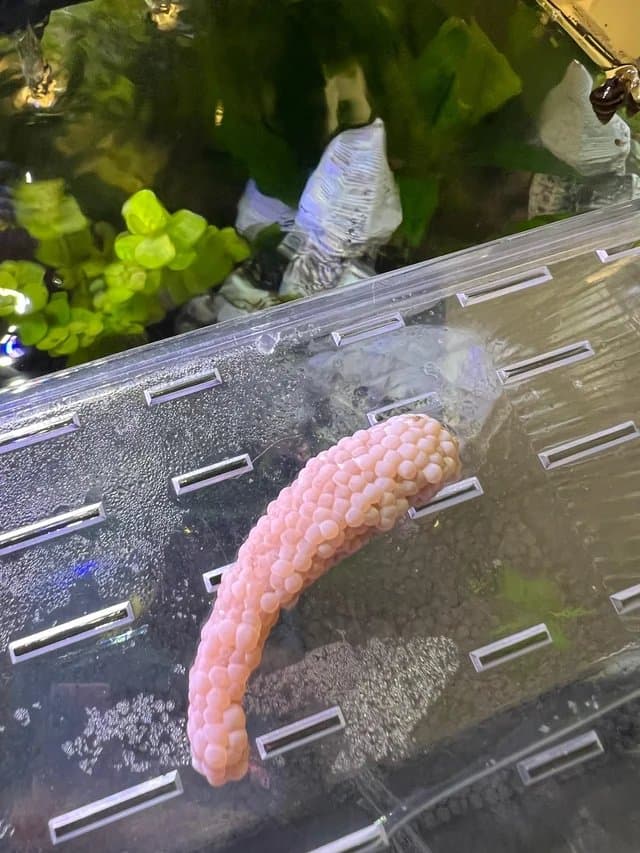
A typical cured mystery snail clutch — pink coloration, jelly-bubble texture, laid above the waterline. This stage is 1–14 days old.
Quick Answer
- What they are: Mystery snail (Pomacea diffusa) eggs — calcified pink clusters laid above the waterline. Each clutch holds 50–300+ eggs.
- Hatching window: 10 days to 4 weeks depending on temperature. At 76–80°F: ~12 days.
- Single snail laying eggs? Normal. Females store viable sperm for up to a year after one mating.
- Should you hatch or remove? Remove unless you have a stocked-down tank (55+ gallons, no predators) AND a rehoming plan. A 200-snail hatch can crash a small aquarium.
- Removal protocol: Wait 24–48 hrs for hardening, scrape with a plastic card, freeze 24–72 hrs at 0°F, dispose in trash. Never flush or release outdoors.
1. What Mystery Snail Eggs Look Like
Mystery snail eggs go through three visible stages over their 2–4 week development. Knowing which stage you’re looking at tells you whether the clutch is fresh, viable, or about to hatch.
Appearance
Pale pink to off-white, jelly-bubble look, soft and sticky
Texture
Gelatinous, will smear if touched
Appearance
Bright pink to coral, calcified, holds shape like a small berry cluster
Texture
Hard, bumpy, brittle if pressed
Appearance
Gray, tan, or bruised — looks moldy but isn't (it's developing shells showing through)
Texture
Very brittle, may show tiny dots inside
⚠ The "dirty gray" stage looks like mold but isn’t.When eggs hit the pre-hatch stage 3–5 days before emergence, the developing baby snail shells inside become visible through the thinning egg walls. This dark, bruised appearance is a sign of imminent hatching — not fungus or rot. Don’t discard a clutch at this stage thinking it’s spoiled.
2. Is It Really a Mystery Snail Egg?
Several aquarium snail species lay eggs in tanks — but only two lay above the waterline, and one of those is a federally regulated invasive. Cross-reference what you see against this table.
| Species | Location | Appearance | Count | Key Tell |
|---|---|---|---|---|
| Mystery Snail (P. diffusa) | Above | Calcified pink/coral cluster on glass or lid | 50–300+ | Always above waterline; pink-to-tan color shift |
| Apple Snail (P. maculata) | Above | Bright fluorescent pink/red mass, larger than mystery | 1,500–4,500 | Massive clutch size; FEDERALLY BANNED — report to USDA APHIS |
| Florida Apple Snail | Above | Large opaque white-pink eggs, larger individual eggs | <100 | Native to FL; eggs much larger than mystery |
| Nerite Snail | Submerged | Tiny flat white/cream sesame-seed capsules | Isolated capsules | Won't hatch in freshwater; harmless aesthetic dots |
| Ramshorn Snail | Submerged | Flat clear gelatinous discs on plants/glass | 10–20 per blob | Multiplies fast in freshwater; usually 'pest' snail |
| Bladder/Pond Snail | Submerged | Tiny clear blobs in jelly mass | 5–20 | Hitchhiker on plants; multiplies rapidly |
🚨 If your clutch has 1,500+ bright pink eggs, that’s NOT a mystery snail. Pomacea maculata (Channeled Apple Snail / Island Apple Snail) is federally banned under USDA APHIS regulations and one of the most destructive invasive species in the southeastern US. Report it to your state agriculture department immediately. Do not move, sell, or release.
3. Why Above the Waterline? The Biology
Mystery snail egg behavior is one of the strangest in the aquarium hobby — adults breathe water AND air, but their embryos can only breathe air. Here’s why that matters.
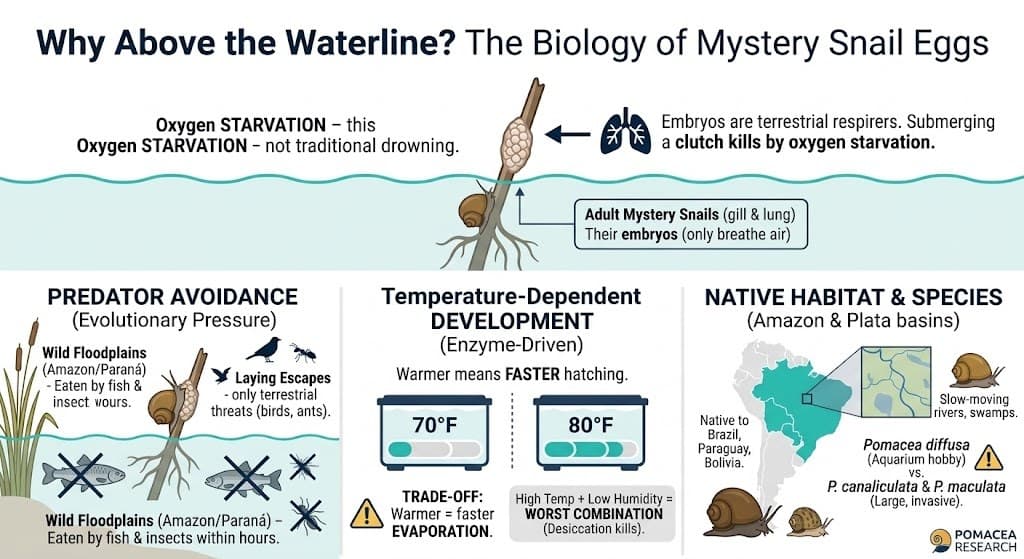
🫁 Embryos are terrestrial respirers
Adult mystery snails have both a gill and a lung-like structure and can submerge for hours. Their developing embryos, however, only respire atmospheric oxygen through gas exchange across the egg membrane. Submerging a clutch kills the embryos within minutes by suffocation — not drowning in the traditional sense, but oxygen starvation.
🌊 Predator avoidance evolutionary pressure
In the wild South American floodplains of the Amazon and Paraná basins, submerged eggs are eaten by fish, crustaceans, and predatory insects within hours. Mystery snails evolved aerial egg-laying as an escape — once a clutch is fixed above the waterline, only terrestrial predators (birds, ants) pose a threat.
🌡️ Why warmer water = faster hatching
Embryonic development is enzyme-driven and temperature-dependent. At 80°F embryos develop roughly twice as fast as at 70°F. The tradeoff: warmer also means faster moisture evaporation, so high temperature + low humidity is the worst combination — desiccation kills clutches before they hatch.
📍 Native habitat: Amazon & Plata basins
Native to Brazil, Paraguay, and Bolivia — slow-moving rivers, swamps, and ponds. The aquarium hobby’s Pomacea diffusa (formerly P. bridgesii) is a different species from the larger, invasive P. canaliculata and P. maculata, despite all three being marketed as "mystery snails" historically.
4. Hatching Timeline by Temperature
The single biggest factor controlling when your eggs hatch is the temperature of the air around the clutch (which closely tracks your tank water temperature if the clutch is on the glass).
Too cold for ideal development
Acceptable but slow
Sweet spot — standard tropical
Fastest, but watch for desiccation
✓ Signs of imminent hatching
- • Clutch turns dark gray, tan, or "bruised"
- • Tiny dots visible inside individual eggs (baby shells)
- • Surface looks brittle, almost crumbly
- • In the last 24 hours, you may see faint movement inside the cluster
✗ Common failure modes
- • Clutch fell in water — embryos drowned
- • Heat lamp too close — desiccated/dried out
- • Tank lid removed too often — humidity crashed
- • Infertile clutch — stains paper towel red after 2 weeks, smells foul
5. Should You Hatch or Remove?
One clutch can produce 200 hatchlings. Before deciding to incubate, run through these 5 factors honestly — if any single one is a red flag, removal is almost always the right call.
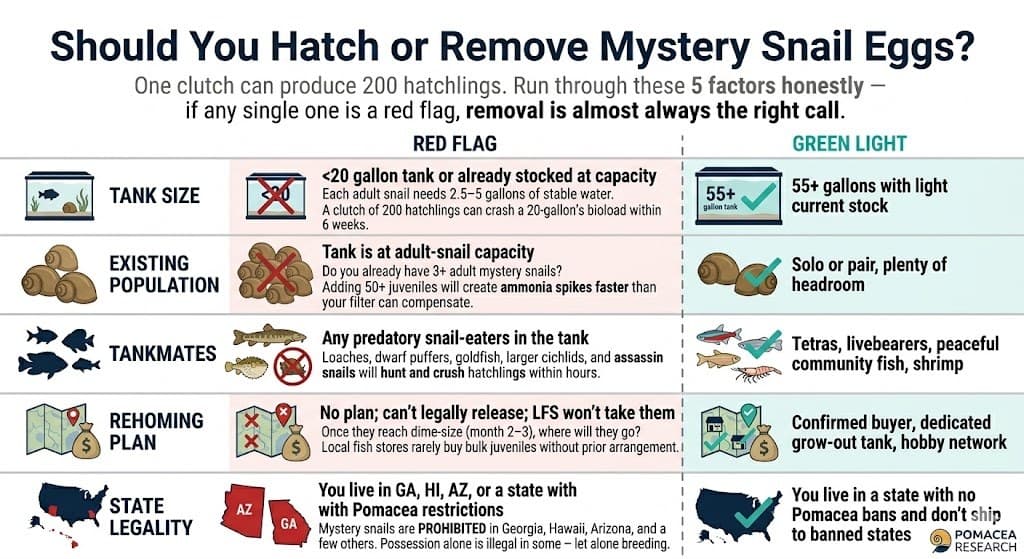
Tank Size
Each adult snail needs 2.5–5 gallons of stable water. A clutch of 200 hatchlings can crash a 20-gallon's bioload within 6 weeks.
<20 gallon tank or already stocked at capacity
55+ gallons with light current stock
Existing Population
Do you already have 3+ adult mystery snails? Adding 50+ juveniles will create ammonia spikes faster than your filter can compensate.
Tank is at adult-snail capacity
Solo or pair, plenty of headroom
Tankmates
Loaches, dwarf puffers, goldfish, larger cichlids, and assassin snails will hunt and crush hatchlings within hours.
Any predatory snail-eaters in the tank
Tetras, livebearers, peaceful community fish, shrimp
Rehoming Plan
Once they reach dime-size (month 2–3), where will they go? Local fish stores rarely buy bulk juveniles without prior arrangement.
No plan; can't legally release; LFS won't take them
Confirmed buyer, dedicated grow-out tank, hobby network
State Legality
Mystery snails are PROHIBITED in Georgia, Hawaii, Arizona, and a few others. Possession alone is illegal in some — let alone breeding.
You live in GA, HI, AZ, or a state with Pomacea restrictions
You live in a state with no Pomacea bans and don't ship to banned states
6. How to Remove Eggs (4-Step Humane Protocol)
If you’ve decided not to hatch the clutch, this is the biosecure way to handle removal — humane to the embryos and safe for your local ecosystem.
- 1
Wait 24–48 hours for the clutch to harden
Fresh eggs are a gelatinous mess — squishing them in-tank releases proteins that spike ammonia and fungus risk. Wait until the clutch is firm and pink/coral colored before you touch it.
- 2
Scrape from the base with a plastic card
Use an old credit card, plastic spatula, or razor blade. Slide flat against the glass at the bottom of the clutch and pop it off in one piece. Try not to crush it.
⚠ Note: If the clutch falls into the tank during removal, scoop it out IMMEDIATELY with a net before the embryos drown — even if you're disposing of it, you don't want decomposing eggs polluting your water.
- 3
Freeze at 0°F (-18°C) for 24–72 hours
Place the intact clutch in a sealed freezer bag and freeze for at least 24 hours. This is the most humane method — embryos lose consciousness within minutes and development halts entirely. Cold is painless and biosecure.
- 4
Crush frozen, dispose in household trash
Once fully frozen solid, crush the clutch through the bag and discard in normal trash. Never flush down the toilet (eggs can survive sewage transit), never put in compost or yard waste (could re-establish in local watershed).
⚠ Note: Releasing mystery snails or their eggs into outdoor waterways is illegal in every US state and ecologically destructive — they outcompete native snails and damage agricultural systems.
7. How to Incubate Eggs (For Hatching)
If you decided to hatch the clutch, you have two methods — leave in place or move to a floating incubator. The incubator approach gives much higher and more reliable hatch rates.
Leave In Place
Easiest method: leave the clutch where it’s laid, with a tight lid for humidity. Hatchlings drop into the tank when ready.
Floating Incubator
Remove the clutch and move it to a controlled humidity chamber that floats in the tank. Highest survival, easy to monitor.
Method B: 6-Step Incubator Setup
- 1
Punch 6–8 air holes in a clear Tupperware lid
Use a 1/8-inch drill bit or push-pin. Air exchange is critical — the embryos breathe atmospheric oxygen, not dissolved oxygen.
- 2
Saturate paper towel, wring damp
Soak a paper towel in tank water (matches tank chemistry, no chlorine), then wring it out until it's only damp to the touch. Line the bottom of the Tupperware.
- 3
Add a dry barrier layer
Place a dry paper towel, a small piece of styrofoam, or a square of plastic craft mesh on top of the damp layer. This is the platform — clutch must NEVER touch standing water or saturated material.
- 4
Place the cured clutch on the dry layer
Use the scraping technique from the removal protocol (Step 2 above) to transfer the clutch intact onto the dry barrier. Position it where you can see it through the lid.
- 5
Float in the heated aquarium
Set the container floating in your heated tank — typically the tank's surface area is 76–80°F, ideal for hatching. The water below keeps temperature and humidity stable.
- 6
Open the lid daily for fresh air
Every 24 hours, lift the lid for 30–60 seconds to refresh air and wipe any condensation that's pooled on the underside (drips onto the clutch = drowning). Mist the paper towel back to damp if it dries out.
8. Caring for 100+ Baby Snails
Hatchlings drop into the water as miniature copies of adults. They’re fragile, vulnerable, and surprisingly hungry. Here’s the first 90 days.
🍽️ First-Week Diet
Hatchlings survive primarily on biofilmin the first 3–5 days — don’t scrub your tank or do major water changes during this window. Supplement with:
- • Powdered or crushed algae wafers
- • Blanched zucchini, cucumber slices
- • Spirulina powder
- • Crushed high-protein fish flakes
🦴 Calcium Sources (Critical)
Rapid shell growth requires calcium. Without enough, hatchling shells stay soft and they die within weeks. Add at least one of:
- • Cuttlebone (cheap, lasts months)
- • Crushed coral substrate
- • Wonder Shell or Snello blocks
- • Eggshell powder (rinsed, dried, ground)
🏠 Nursery Tank Setup
- • Bare-bottom tank — easier to see and feed hatchlings; no substrate to get lost in
- • Sponge filter only — HOB and canister filters suck up baby snails
- • Same temp as parent tank — 76–80°F
- • Stable pH 7.0–8.4 with calcium-rich water
📅 Growth Timeline
- • Week 1: Visible only against dark backgrounds (~2mm)
- • Week 3–4: Pea-size, eating visible amounts
- • Month 2–3: Dime-size — ready to sell or rehome
- • Month 3–6: Sexually mature, can start their own clutches
9. Mystery Snail Reproduction FAQ
The most common questions we get about mystery snail eggs and reproduction — answered.
I only have ONE mystery snail. How can there be eggs?+
How do I tell male from female mystery snails?+
How often will my snail lay eggs?+
Do mystery snail eggs need to be in water to hatch?+
What if my eggs fell into the water?+
Can mystery snails crossbreed with apple snails or nerites?+
How can I get my mystery snail to lay eggs?+
Why aren't my eggs hatching after 4 weeks?+
Will mystery snails take over my tank?+
Can I legally sell or ship mystery snail babies in the US?+
10. Color Genetics Primer
Two gold parents can produce a wild-type brown offspring. Wonder why? Mystery snail shell color is controlled by three genetic loci that combine to produce every color in the hobby.
Locus A (Body Pigment)
Controls the foot and tentacle color you see at the snail's mantle
Locus Y (Shell Color)
Determines whether the shell itself is pigmented or translucent
Locus S (Shell Striping)
Controls whether shell shows the classic spiral banding
Rarity Tiers
Gold (yellow shell, dark body)
CommonThe hobby's iconic mystery snail — gold shell over dark body
$5–8 wholesale
Wild-type Brown/Striped
CommonThe natural form before selective breeding — brown striped shell, dark body
$4–7 wholesale
Ivory (white shell, light body)
PopularPure cream shells against bright foot — recessive at both A and Y loci
$7–10 wholesale
Blue (light shell, dark body)
PopularSilvery-blue shell illusion — recessive Y with dark body
$8–12 wholesale
Black
PremiumDeep ebony shell — heavy melanin expression at the Y locus
$8–14 wholesale
Magenta / Purple
RareDeep burgundy with spiral banding — the prize of selective breeding programs
$12–25 wholesale
Jade
RareOptical illusion: dark body seen through translucent yellow shell creates blue-green sheen
$15–30 wholesale
💎 The "Jade" mystery snail isn’t actually green-pigmented. It’s an optical illusion — a dark melanin body viewed through a translucent yellow shell creates a blue-green sheen via light scattering. True jade-colored shell pigment doesn’t exist in Pomacea diffusa; the appearance is genuinely an optical effect of two specific recessive combinations.
11. US Legality & the "Regulatory Dumping" Problem
Mystery snails are federally exempt from the Lacey Act for interstate movement — but several US states have their own bans. Knowing where you can legally keep, breed, and ship is critical.
Georgia
TotalSweeping ban on all Pomacea including P. diffusa — possession, sale, transport prohibited
Hawaii
TotalAll freshwater snails prohibited — strict invasive species enforcement
Arizona
Family-levelFamily-level Ampullariidae ban technically outlaws all mystery and apple snails
Florida (some counties)
StrictPossession allowed but release into any waterway is a third-degree misdemeanor
Texas
StrictRestricted import; sale typically requires permit
The Regulatory Dumping Problem
When states pass sudden, sweeping mystery snail bans (Georgia’s 2024 ruling is the most recent example), hobbyists often find themselves overnight with snails they can’t legally sell, ship, or rehome. Local fish stores can’t accept them. Interstate shipping becomes legally risky.
The unfortunate result: panicked owners release unwanted snails into local waterways — exactly the environmental risk the law was written to prevent. Released Pomacea outcompete native gastropods, damage rice and water taro crops, and have no effective natural predators outside their home range.
The responsible alternative is freezing.24–72 hours in a household freezer halts all biological activity humanely and biosecurely. If you’re in a state that’s newly banning Pomacea, freeze any unwanted clutches and adult snails rather than releasing them — it’s the only outcome that doesn’t accelerate the environmental damage.
Looking for Mystery Snails?
We ship tank-raised Pomacea diffusa mystery snails to compatible US states with live arrival guarantee on overnight orders. Juvenile size (1/2 to 1 inch) — they color up and mature over the first few months in your tank.
3-Pack Assorted
Surprise color mix
$24.99
10-Pack Assorted
Best per-snail price
$59.99
3-Pack Blue
Silvery-blue shells
$29.99
3-Pack Purple
Premium rare color
$32.99